
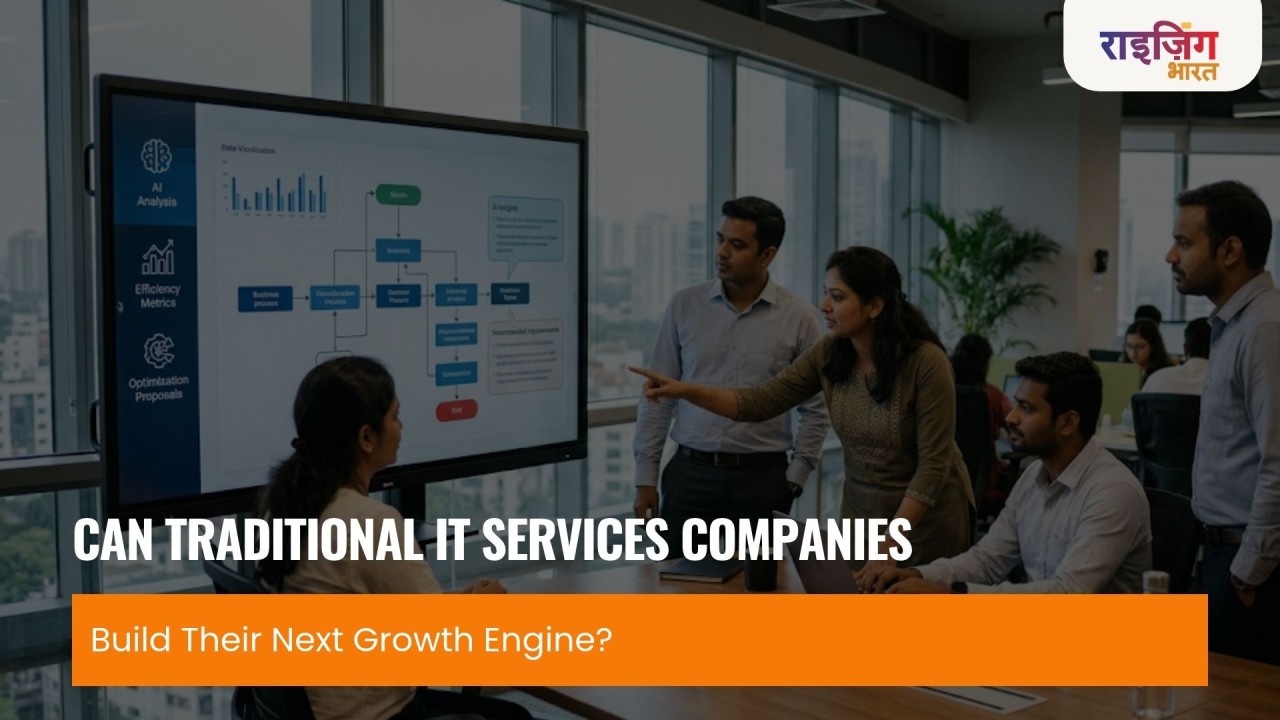
Can Traditional IT Services Companies Build Their Next Growth Engine?
 By sonali.kohli
26 Nov 2026
3 min read
For decades, India’s IT services industry built its global reputation on a relatively straightforward proposition: skilled engineers, competitive costs and the ability to deliver technology services at scale. Global companies outsourced software development, infrastructure management, testing and business processes to Indian technology firms, creating an industry that became one of the country’s largest sources of export revenue.
But the economics of that model are changing. Artificial intelligence, automation and the growing demand for measurable business outcomes are forcing IT services companies to reconsider what clients are paying for—and what they should be selling next.
The traditional model largely rewarded scale. More projects meant more engineers, more billable hours and higher revenue. AI is beginning to challenge that relationship. Tasks that once required large teams can increasingly be completed with smaller teams using AI-assisted coding, automated testing and intelligent workflow tools. This can improve delivery efficiency, but it also raises a difficult question: if technology reduces the number of hours required to complete a project, how should service providers price their work?
The answer may lie in moving away from selling effort and towards selling outcomes.
Under conventional contracts, clients often pay for the number of people deployed or the hours spent delivering a service. Outcome-based pricing links payment more closely to what the service actually achieves. This could mean faster software releases, lower infrastructure costs, improved customer response times or more efficient business processes.
For clients, the attraction is clear. They want productivity gains rather than simply access to additional technology workers. For IT services companies, however, the transition requires a different commercial approach. Providers must demonstrate measurable value, take greater responsibility for delivery and develop a deeper understanding of the client’s business.
AI also creates an opportunity for companies to move higher up the technology value chain. Instead of limiting themselves to implementing software built by others, service providers can develop proprietary platforms, industry-specific AI solutions and reusable automation tools. Their accumulated experience across banking, healthcare, manufacturing and retail gives them an understanding of complex business processes that can be valuable when designing specialised solutions.
Yet this transition will not be automatic. Companies have to invest in AI capabilities, retrain employees and rethink how projects are staffed and managed. They also face the challenge of protecting existing revenue streams while building new ones. If automation reduces the number of billable hours, productivity gains must eventually translate into new services, stronger margins or alternative pricing structures.
The workforce implications are equally significant. Demand may shift away from repetitive coding, testing and maintenance towards AI orchestration, architecture, cybersecurity, domain expertise and complex problem-solving. This does not mean human expertise becomes less important. It means its value may increasingly depend on the ability to work alongside intelligent systems and solve problems that automation alone cannot address.
For India’s established IT services companies, the next growth engine may therefore not come from hiring more people to execute larger projects. It could come from combining human expertise, proprietary technology and AI-driven productivity to deliver outcomes clients are willing to pay for.
The industry has spent decades proving that it can deliver technology at scale. Its next challenge is proving that it can create measurable value in a world where technology can increasingly do more with less.