
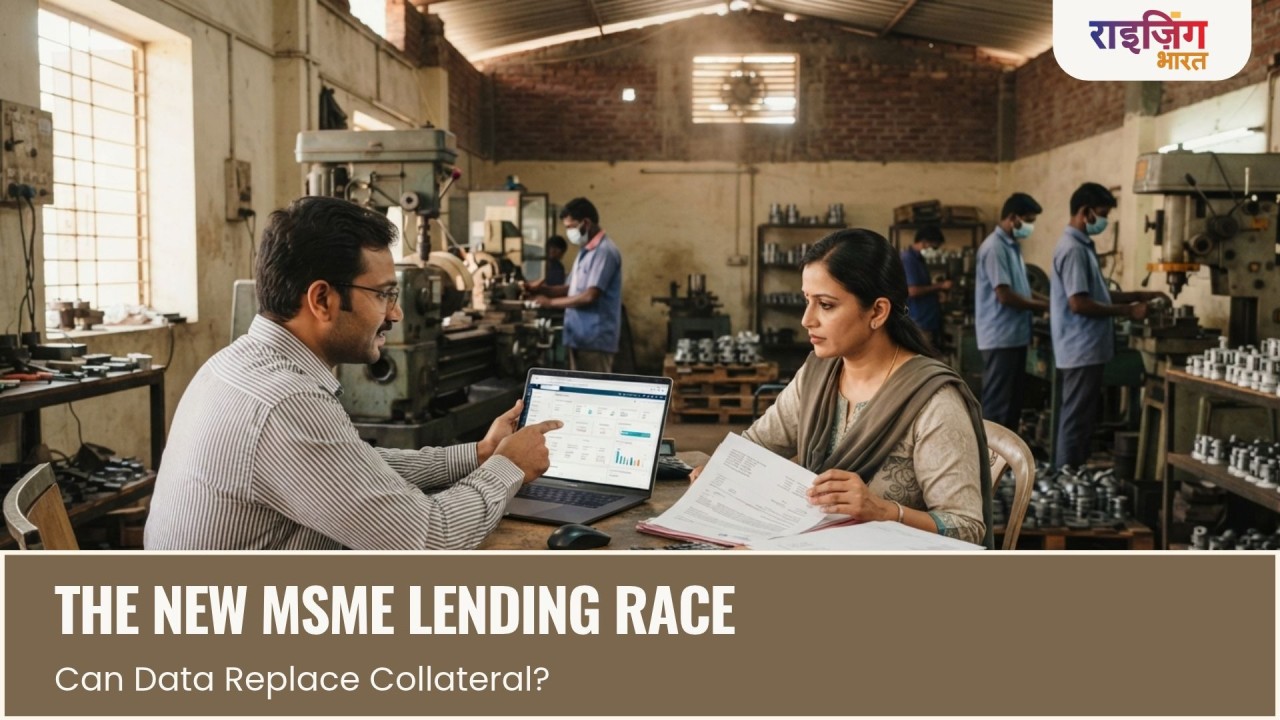
The New MSME Lending Race: Can Data Replace Collateral?
 By sonali.kohli
26 Nov 2026
4 min read
A small manufacturing business may have regular orders, repeat customers and healthy sales, yet struggle to secure a bank loan because it does not own property to pledge as collateral. For decades, this has been one of the central contradictions in India’s MSME financing system: businesses with genuine commercial potential can remain credit-starved because lenders have limited ways to assess their financial health.
That equation is beginning to change. As more businesses leave digital footprints through GST filings, UPI payments, banking transactions and online marketplaces, lenders are finding new ways to evaluate creditworthiness. Instead of looking primarily at the assets a business owns, they can increasingly examine how money moves through it.
The opportunity is significant. SIDBI(Small Industries Development Bank of India) ‘s May 2025 report estimated India’s addressable MSME credit gap at approximately ₹30 lakh crore, equivalent to around 24% of estimated overall finance demand. Limited financial history, inadequate collateral and information asymmetry remain major barriers to formal borrowing.
Digital underwriting attempts to address this information problem. GST returns can offer insights into sales and business activity, while bank statements reveal the frequency and consistency of cash flows. Transaction histories can help lenders understand seasonal patterns, payment cycles and the ability to meet repayment obligations. Account Aggregators allow financial information to be shared securely with lenders, with the borrower’s consent, making it easier to build a more complete picture of a business.
The shift is already moving beyond experimentation. Public sector banks sanctioned more than 3.96 lakh MSME loan applications worth over ₹52,300 crore under digital credit assessment programmes between April and December 2025. The model uses digitally verified information, including GST data, bank statements accessed through Account Aggregators, income-tax returns and credit bureau records, to support loan appraisal and reduce paperwork.
The Reserve Bank of India (RBI) is also developing the Unified Lending Interface (ULI), which can bring together information such as GST filings, bank statements, utility records and land records through a single consent-based interface. The objective is to help lenders assess businesses with limited credit histories without relying entirely on lengthy documentation and physical verification.
However, data-driven lending does not mean collateral has become irrelevant. It changes how lenders assess risk, but does not eliminate the risk itself. A business may have strong digital sales but uneven cash flows, delayed customer payments or thin operating margins. Transactions alone cannot always distinguish sustainable profitability from temporary revenue spikes. Data gaps, inaccurate records and inconsistent digital adoption can also leave many smaller enterprises outside automated lending systems.
There are signs that lenders must remain cautious. SIDBI’s July 2026 MSME Pulse noted that early delinquencies in certain unsecured business-loan cohorts were significantly higher than the overall level. For March 2025 originations, accounts in unsecured business lending showed 2.9 times higher 90-day-plus delinquency within the first 12 months compared with the overall portfolio.
This is why the next phase of MSME lending is likely to combine digital underwriting with traditional relationship banking, credit guarantees and human assessment. The RBI has doubled the collateral-free loan limit for micro and small enterprises from ₹10 lakh to ₹20 lakh, with the possibility of extending it to ₹25 lakh for businesses with a consistent financial track record. Credit guarantees through CGTMSE-India can further reduce lenders’ exposure when viable enterprises lack assets to pledge.
Ultimately, data may not replace collateral for every borrower, but it can reduce the extent to which the absence of collateral determines a business’s access to credit. The larger shift is from asking what an entrepreneur owns to understanding how the enterprise actually performs.
For India’s smaller businesses, that could prove to be a more consequential change than faster loan approvals. It could make the ability to generate business, manage cash flows and repay debt count as much as the property on a balance sheet.
Add a sharper Bharat-focused openingClarify how data replaces collateral.