
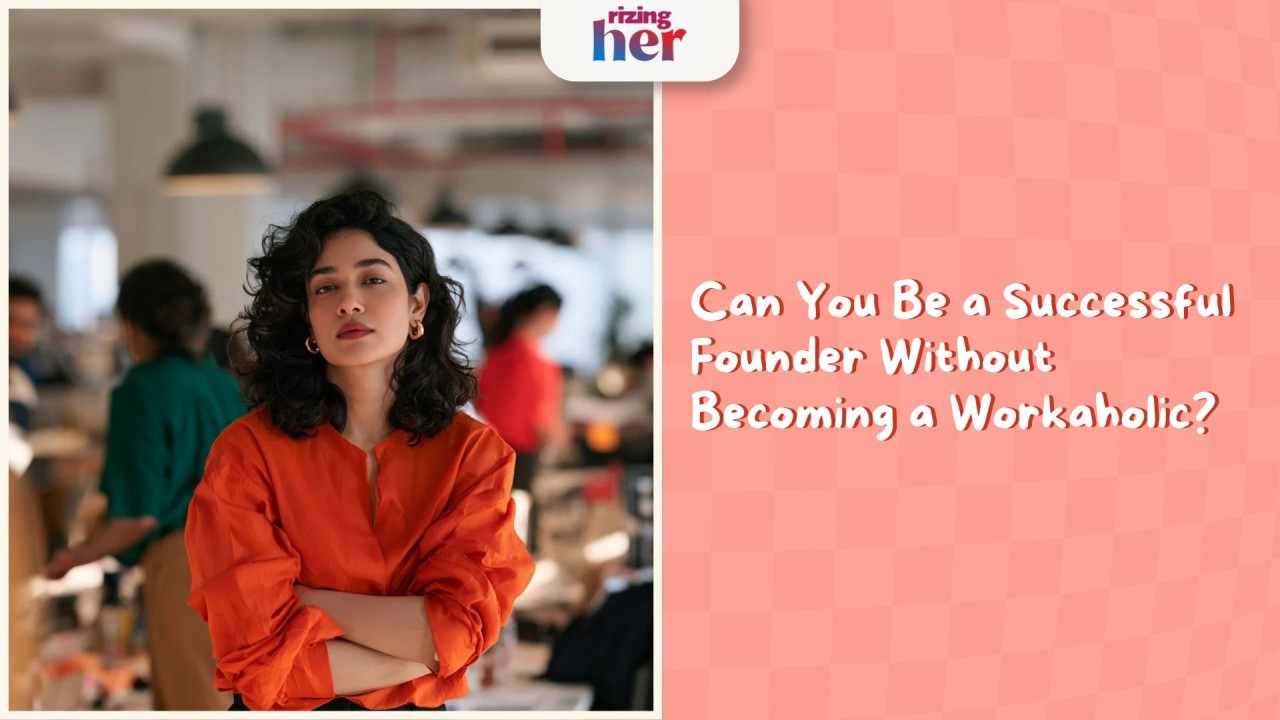
Can You Be a Successful Founder Without Becoming a Workaholic?
 By sonali.kohli
26 Nov 2026
3 min read
Entrepreneurship has a peculiar relationship with exhaustion. Long working hours, missed holidays, late-night emails and weekends spent chasing deadlines are often presented as badges of honour. The founder who works 16 hours a day is celebrated for commitment, while the one who switches off at a reasonable hour can sometimes feel as though she is not doing enough.
For women building businesses, this pressure can become even more complicated. Alongside the demands of running a company, many are also navigating family responsibilities, caregiving and expectations around being present at home. The result can be an exhausting attempt to prove that they are equally committed to both their businesses and their personal lives.
But does building a successful company really require becoming a workaholic?
The startup ecosystem has long celebrated the idea of the founder who is available around the clock. In the early stages, some degree of intense involvement is often unavoidable. Founders handle everything from product development and customer acquisition to hiring, finance and operations. When resources are limited, working longer hours can seem like the only way to keep the business moving.
The problem begins when temporary intensity becomes a permanent operating philosophy.
A business that depends entirely on its founder’s constant availability may be growing, but it is not necessarily becoming stronger. When every decision requires the founder’s approval, every customer relationship depends on her involvement and every operational problem lands on her desk, the company can struggle to function independently. What looks like dedication can gradually become a bottleneck.
Sustainable entrepreneurship requires a different approach. It involves building systems, hiring people who can take ownership and creating processes that allow decisions to happen without constant intervention. Delegation is not simply about reducing a founder’s workload. It is about building an organisation that can grow beyond one person’s capacity.
It also requires a more realistic understanding of productivity. Spending more hours at work does not automatically translate into better decisions, stronger leadership or improved business performance. Exhaustion can affect judgement, creativity and the ability to respond calmly to difficult situations. For founders making decisions that influence employees, customers and investors, the quality of their thinking matters.
For women entrepreneurs, redefining success also means questioning the expectation that personal sacrifice is proof of ambition. Choosing to spend time with family, protecting personal space or taking a break should not automatically be interpreted as a lack of commitment. A founder’s ability to build a business and maintain a life outside it should not be treated as mutually exclusive.
This does not mean entrepreneurship can always be predictable or neatly balanced. There will be difficult periods, unexpected crises and moments when the business demands more attention. But those periods should not become the permanent measure of a founder’s worth.
Perhaps the more useful question is not how many hours a founder works, but whether the business is becoming less dependent on those hours over time.
A successful founder should be able to build something that creates value without requiring her to sacrifice every other part of her identity. After all, the purpose of building a business should be to create greater possibilities, not to become permanently trapped by the very thing you created.