Author name: sonali.kohli

RizingTV

Venture Intelligence Weekly: Deep Dive, Week of 16–20 November 2026

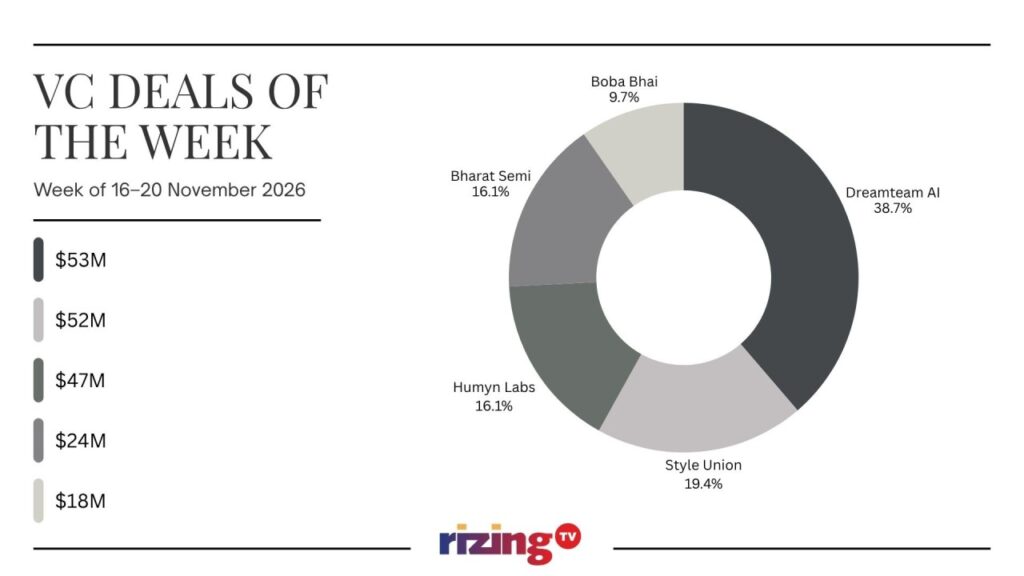
The report covers 17 deals worth $231 million in the week, bringing the 2026 year-to-date count to 849 deals and $8,821 million. The five notable deals account for about $173 million, roughly three-quarters of the week’s value. The report does not label a deal of the week, so the pick below is our editorial call. Corrections to check before the segment Several entries in the report need adjusting. Humyn Labs’ $26 million is only the equity portion of a $47 million round, which also includes $21 million of venture debt. Style Union’s round was led by Venturi Partners with Elev8 Venture Partners as co-lead, and it mixes primary and secondary capital. Bharat Semi’s round was led by Info Edge, South Park Commons and Indus Bridge, and the report’s list omits those leads. Boba Bhai ‘s round was led by Left Lane Capital , which the report does not say. Finally, Dreamteam’s $53 million covers both its seed and Series A rounds, and the company has not disclosed the split. Deal of the week: Dreamteam AI Dreamteam is an AI-native customer relationship management platform founded in 2025 by three former Freshworks executives. It came out of stealth with $53 million to challenge Salesforce and HubSpot, and the round comprises seed and Series A rounds, led by Together Fund and Accel respectively, with participation from Premji Invest. The company declined to disclose the size of each round or its valuation. We chose it as the deal of the week for three reasons. It is the largest notable deal, at about 23 percent of the week’s value. It brings together a founder-run fund, a global venture firm and a major Indian family investment house, which signals institutional conviction across the seed and growth stages. And it is a clear test of whether AI can actually displace entrenched enterprise software. The platform is built around a shared memory of customer interactions and four specialized AI coworkers. Investors are betting that a CRM designed around AI from the start can beat incumbents that have added AI to older architectures. The rewards case rests on the size of the opportunity and the team. CRM is a large, sticky software category, and a credible AI-native challenger could take share. The founders’ operating experience at Freshworks, a listed SaaS company, gives them real knowledge of how this market buys. The company also claims that more than 100 customers signed in three months of selling, which TechCrunch reported from founder interviews. That is a useful early signal, but it is a company claim rather than verified data. The risks are substantial. Salesforce and HubSpot have deep distribution, and enterprise customers are slow to migrate systems. The company is young, and its valuation is undisclosed, which makes it hard to judge the price of the round. Its plans for the capital have not been spelled out in detail either, as the startup did not elaborate how it plans to utilise the funds. The AI-agent category is also crowded, and a product that works in demos may struggle in complex enterprise deployments. On the investors, Accel is one of the most active early-stage firms in India. It has closed a ninth India fund of $550 Mn as part of a larger raise, and it says it 95% of investments coming at the seed or Series A stage. Together Fund is more distinctive. It was set up in 2021 with an initial corpus of $85 million and is led by Girish Mathrubootham of Freshworks, Manav Garg of EKA Software Solutions and Shubham Gupta, formerly of Matrix Partners India. It is seeking a second fund worth $150 million for Indian SaaS and AI companies. Mathrubootham stepped down as executive chairman of Freshworks on December 1, 2025 to focus on Together. Premji Invest is the investment arm of the Azim Premji group, which brings a long-established Indian corporate investor into the round. Other notable deals Style Union (₹485 crore, about $52 million). This is a value fashion retailer whose parent, Style Union-Nexon Omniverse Limited , secured Rs 485 crore in a Series E funding round. The round is led by Venturi Partners , with Elev8 as co-lead. The company reported revenue of over Rs 1,150 crore for FY26, and the money will fund expansion from its southern base into West and North India. The reward is a profitable, fast-growing retailer in a large consumption category. The risks are competition from organised players, and the fact that the round combines primary and secondary capital, so not all of it goes to the business. The company’s plan is to reach 450 stores by March 2030, which will test its execution. Humyn Labs ($47 million, including $26 million equity). Humyn Labs supplies real-world human behaviour data to robotics and AI companies. Its equity is led by Accel, with participation from Prosus Ventures , BeeGlobal and Bajaj’s Finserv Intelligence. The company was founded in February 2026 and has 51 full-time employees. The company says it has surpassed USD 50 million in annualised revenue within six months of operations, which is a striking claim for a company this young and should be verified before it is broadcast. The opportunity is real, since physical AI needs training data, but the business depends on a small number of frontier customers. Bharat Semi ($24 million seed). This Indian semiconductor startup is developing programmable image sensors that combine capture, processing and AI on one chip. The round is all-equity, and the company is pre-revenue. The reward is a foothold in physical AI hardware, a market where Indian players are few. The risks are long development timelines and capital intensity. The company is fabless, which keeps its spending on design, and the company says the money will not finance a separate fabrication project. Its initial commercial production is targeted for 2027. Boba Bhai ($18 million Series B). This bubble tea and Korean street food chain is led by Left Lane Capital, which is the fourth company in India to be backed by Left […]

RizingTV

Brands, Staged Buyouts and One Big Plate: Inside a Thin Week for M&A

Rizing TV M&A Deals Report Card, Week of Nov 9, 2026 India’s M&A market recorded 11 deals worth $207 million this week, against a year-to-date total of $46,355 million across 498 deals. The deal count matches the year’s average of about 11 a week. The value is only a fifth of the typical weekly total of about $1 billion (our arithmetic). The average deal this week was about $19 million, against $93 million for the year. Year-to-date totals also imply the previous week brought seven deals worth around $2.9 billion, so this was a sharp drop after a heavy one. The five notable deals add up to $207 million, which is the entire reported value. The other six carry no disclosed price. Bodhi Tree’s purchase of Adyar Ananda Bhavan alone is 87% of it. The deal of the week: A2B BODHI TREE SYSTEMS PRIVATE LIMITED , the platform backed by James Murdoch ’s Lupa Systems and Uday Shankar, will invest $180 million for a majority stake in the Chennai restaurant and sweets chain. The exact holding was not disclosed, but the cheque buys control and makes Shankar chairman of A2B’s new board. An industry source put the business at about $350 million. The numbers are the interesting part. In the year to March 2025, A2B’s main Indian entity reported sales of ₹1,487 crore ($158.8 million) and a net profit of ₹36.2 crore ($3.9 million). That implies a valuation of about 2.2 times sales but roughly 90 times last year’s profit (our arithmetic), on a net margin near 2.4%. Bodhi Tree is paying for brand, scale-up potential and a long runway, not today’s earnings. The firm has backed media and education before, with ₹13,500 crore in Viacom18 Media Private Limited and $600 million in ALLEN Career Institute Overseas , and this is its first food bet. The rewards are clear: a trusted 1979-born brand, a path to national and overseas growth, and professional management. The risks are equally clear: thin margins, the challenge of keeping quality consistent across many outlets, and a price that leaves little room for error. Marico’s two-step playbook Marico accounts for two of the five deals, together worth about ₹149 crore, both announced on November 6. In Cosmix Wellness, it paid ₹113.65 crore for another 20%, lifting its stake to 80%, with a right to buy the rest after FY29. That price implies a valuation near ₹568 crore. In February, it paid ₹225.67 crore for 60% at a value of about ₹375 crore, so the implied value is roughly 50% higher in nine months (our arithmetic). The second tranche may have been priced in advance, which would explain the jump. Either way it shows the plant-based nutrition brand growing, or Marico paying up to lock it in. Bonorizon Consumer Ventures is a different animal. Marico will take 51% through a primary subscription for up to ₹35 crore. The company was incorporated on October 22, only two weeks before the agreement, so there is no operating history. Marico has an option on the remaining shares after three years, and ties the deal to its overseas and digital plans. It is a bet on the founders and the idea, with Marico limiting its downside by buying in stages. Squeezing out the minorities Pininfarina. Tech Mahindra ’s arm PF Holdings, a vehicle in which Tech Mahindra holds 60% and Mahindra and Mahindra Limited [Automotive and Farm Equipment Business] 40%, has committed to buy 10.02% of the Italian design house for up to €9.46 million. That would take its holding from 82.57% to 92.59%. It is part of a voluntary tender offer for up to 17.42% that sits alongside Pininfarina ’s plan to delist from Borsa Italiana. The price of €1.20 a share compares with €1.10 paid for the original 76.06% in 2015, an increase of about 9% in a decade. The company’s turnover was €102.7 million in 2025, up from €91.1 million, so the whole company is valued at about 0.9 times sales (our arithmetic). Completion needs Italian government approval. Astro-Vision. Matrimony.com Limited will pay ₹8 crore for another 50%, taking its holding from 26.09% to 76.09% and making the astrology software firm a subsidiary. Astro-Vision ’s revenue was ₹20.57 crore in FY26, barely up from ₹20.02 crore. If the price scaled straight to the whole business, it would value it at about ₹16 crore, under one times revenue, though the stake purchase should not be read as a clean valuation. The strategic logic is tighter integration with the matchmaking platform, and flat growth suggests the value is in the fit rather than expansion. The pattern Three of the five notable deals are about raising an existing stake: Marico Limited in Cosmix, Tech Mahindra in Pininfarina, and Matrimony. com in Astro-Vision. A fourth, Bonorizon, builds in a purchase option, and Cosmix does too. Buyers are paying in stages and keeping the right to buy the rest. That reduces risk, and it gives sellers something to work for. Only A2B is a big, one-step purchase, and it is a private investor taking control of a consumer brand rather than a strategic buyer. Disclosure is also a story. Six of 11 deals gave no price, so the week’s total understates activity.

RizingTV

Rizing TV VC Deals Report Card, Week of Nov 9, 2026

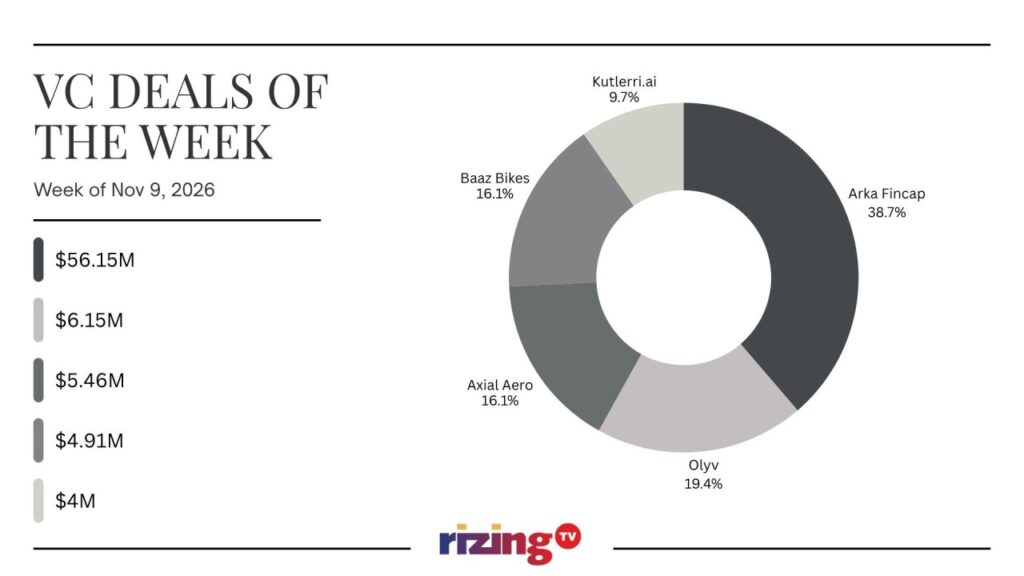
Indian startups raised about $83 million across 10 deals this week, against a year-to-date total of $8,590 million across 832. That is roughly half the year’s average weekly pace of about 18 deals and $190 million (our arithmetic). The year-to-date figures also imply about 20 deals worth around $274 million in the week of Nov 2, so this was the quietest of the last three weeks. One deal dominates. Arka Fincap Limited ’s $56.15 million from TPG is 68% of the week’s value, and the five notable deals together make up 92%. Strip out Arka and the other nine deals averaged about $3 million. Deal of the Week: Arka Fincap We pick Arka for three reasons. It is by far the largest cheque. It is a rare global-fund bet on a corporate-backed lender moving into retail credit. And its structure shows how a seasoned investor protects itself. TPG’s The Rise Funds, its impact-investing arm, signed to invest ₹525 crore in a first tranche, with a further ₹275 crore tied to business milestones and regulatory approvals, for up to ₹800 crore. The money comes through equity and compulsorily convertible preference shares. TPG gets one board nominee, customary minority protections and exit provisions. Kirloskar Oil Engines Limited ’ stake falls from 90.279% to 68.587% after the first tranche and to 62.607% after the second. What Arka does. It began operations in 2018 and has about ₹8,000 crore of assets under management. Its secured retail book is just over ₹1,000 crore, served by 146 branches in ten states. It lends for pre-owned vehicles, secured business loans and loans against property, and still runs a wholesale book. It is rated CRISIL AA/Stable. The capital is for geographic expansion, technology and risk management. The investor. TPG is a global alternative asset manager. The Rise Funds is its multi-sector impact strategy, so Arka’s focus on entrepreneurs, MSMEs and vehicle operators fits. Avendus advised Arka, AZB acted for it, and Cyril Amarchand Mangaldas acted for TPG. The rewards. Pricing and scale. From the share counts, the first tranche is priced at about ₹16 a share and the second at about ₹21, roughly 32% higher (our arithmetic). That implies a post-money value near ₹2,200 crore, about 27% of AUM, and a higher price for Arka if it meets its milestones.Parent protection. Kirloskar gets growth capital for its lender without calling on its engine business’s balance sheet, and keeps control.Lock-in. Kirloskar has agreed that its NBFC lending will run only through Arka, and has promised not to invest in other NBFCs. The risks. Mix shift. Secured retail is only about an eighth of the book. Moving from wholesale to retail raises operating and collection costs, and it will test Arka’s underwriting in used-vehicle and small-business loans, which are cyclical.Milestones. The second tranche depends on targets and approvals not yet disclosed.Governance. TPG’s board seat and protective rights narrow Kirloskar’s freedom over time.Classification. This is growth equity into a subsidiary, not a startup round, so treat the weekly total with care. Other notable deals Olyv The digital lender raised ₹57.62 crore (about $6.15 million) as an extension to its Series C. It follows a ₹207 crore Series C in February led by Fundamentum with SMBC Asia Rising Fund , taking the combined round to about ₹265 crore. The report lists Fundamentum first, but coverage says the new money was led by Nippon India Digital with ₹50 crore. February’s round valued Olyv at about ₹1,045 crore, and the company has targeted $1 billion in AUM by FY29. The risk is the usual one for unsecured digital lending: credit quality and regulation, with a fresh Japanese strategic investor now on board. Axial Aero . The Hyderabad-area company makes 360-degree flight simulators for military and commercial pilot training. Two former Indian Air Force pilots are behind its full-flight simulator, shown at Aero India 2025. In September, Indo National invested ₹3.91 crore for 7.97%. That implies a valuation near ₹49 crore, so a $5.46 million round roughly two months later suggests a large step-up. We could not find details of the new round beyond the report. Defence training is a long sales cycle, and government procurement is slow. Baaz . The Delhi-area electric scooter platform for gig delivery riders raised $4.91 million from BIG Capital , Kalaari Capital and others. It sells scooters to rental partners and runs a battery-swap network, and Dealroom records a $40 million valuation at its $2.2 million extension in July 2025. This is a third raise largely from existing backers, which shows loyalty but also that fresh investors are not rushing in. The risk is the economics of swap networks and dependence on delivery platforms. Kutlerri.ai . ai. The $4 million from Houston-based Narahari Investments backs AI agents for restaurants. The company says its agents grow revenue and cut costs and that customers pay only for outcomes. It is US-based, so it is the odd one out in an India report. The pattern Four of the five notable deals come from known backers adding more capital: Kirloskar’s lender, Olyv’s insiders, Baaz’s investors and Axial’s existing strategic shareholder. Money is flowing to companies that already have a track record, in lending, mobility and defence, and little is going to brand-new ideas.

RizingTV

Tech Depth, Distribution or Domain? Two VCs Disagree on What Survives in AI

On The Mindshift, Nexus Venture Partners ’ Amrut Rajkarne and Capria Ventures ’s Saurav Gopal explain where they are betting, what keeps them awake, and what it all means for India’s graduating class. Shrija Agrawal opened with an unusual request: describe AI as a country. Amrut Rajkarne, a vice president at Nexus Venture Partners who studied at Indian Institute of Technology, Kharagpur and Harvard Business School , built the map from the ground up. Electricity and water feed GPUs, which turn them into tokens, the “natural resource” of this nation. Governance sits above that. His point is that governance has to be deterministic, while today’s models are probabilistic, so a new verification layer is needed. Tools are the railroads, and applications and agents are the buildings. The country, he said, is built for humans and agents together. Saurav was part of the founding team at 2070 Health , where he helped shape healthcare investment theses and evaluate new ventures. His earlier work includes building AI products and process automations for large enterprises at Straive and founding The Growth Club, an edtech venture. He holds an MBA from the Indian Institute of Management, Indore . Saurav invests from an early-stage AI fund at Capria. Where they are betting Amrut said he tries not to be thesis-driven, but he named three areas. The first is verification: systems that can prove an AI output is right in tax, legal and healthcare. He backs Pramaana Labs , which raised a $27 million seed round in June, with Nexus among the participants. The second is AI-native services, because most enterprises have licences but no plan for where AI fits in their workflows. The third is consumer AI, which he thinks is waiting on cheaper inference and better memory. Saurav sorted companies into three types: AI-native firms with unusually high revenue per employee, software companies adding AI, and firms that build for AI labs, such as data providers. He highlighted services businesses being rebuilt with AI, and platforms that match supply and demand. His example was a procurement platform whose agents learn what suppliers offer, so it can monetise the supply side as well as the buyer. Over time, he said, that becomes a network effect. The red flags Here the two diverged. Amrut ranked the old software moats for the AI era: tech depth first, distribution second, domain expertise third. Domain knowledge, he argued, can now be learned fast by someone AI-native. Models change every few weeks, so he backs teams that can keep navigating that churn. He also warned against mistaking early revenue for product-market fit. Citing a study from a large global fund, he said the bottom quartile of AI companies now goes from zero to about $2 million in revenue in its first year. He looks at retention and depth of use instead. Saurav warned against founders who treat a technical edge as permanent. Researchers leave labs and start rivals, and engineers re-create what incumbents built. What lasts, he said, is customer obsession, a lead you keep extending, and an ecosystem that becomes hard to leave. He also screens for candour: founders who can list six or ten ways their company could fail get more of his time than those who say nothing can go wrong. What happens to jobs Neither guest sees a jobless future, and both were open about what they don’t know. Saurav described three patterns in every tech wave: roles merge, split or evolve. On the consumer side, product and engineering are merging. On the platform side, roles are splitting into specialist jobs that pay more, and in pharma regulatory work the task is shifting from writing documents to judging them. His advice is to choose a path deliberately and build the skills it needs. Amrut compared AI to tools like Canva and Figma , which opened design to many more people. He expects solo businesses to benefit most. His open question was what a fresh graduate should do now, since AI is doing much of what his own first job involved. How investment firms will change Asked what a large private equity firm should do, Saurav said the biggest funds already know what they are doing. Amrut pointed to AI-led rollups, where firms buy many small services companies and use AI to unify them, and to growth investors entering at Series B or C rather than D or E. He added that investors may have to give up the idea of never losing capital. He also noted that rounds labelled “seed” now run to hundreds of millions of dollars. Advice to policymakers Amrut wants the cost and time of starting a business to approach zero, more investment in advanced manufacturing and semiconductors, and water and climate rules for data centres, since India is water-scarce. Saurav praised the government’s deep-tech funds but pointed to the 98%: entry-level and blue- and grey-collar workers, whom he thinks need thought about protection without choking innovation. He also pointed to the RBI’s circular on AI voice bots used to sell loans as the kind of sector rule to expect more of. Rapid fire Both picked Claude AI . Their message to Sam Altman was about openness: when will his company open-source its models, and what is the date plan? On staying current, Amrut reads research papers on print-outs and runs a set of AI agents to summarise and build his own knowledge graph. Saurav speaks to operators, uses AI to study the history of deals and tech cycles, and is building his own distribution through content.

RizingTV

Honey Trap, Real Law: Why Jensen Huang’s Scandal Is Not (Yet) a Crime

On Sunday, the head of one of the world’s most valuable companies apologised to his employees. By Monday, Nvidia’s shares had closed down more than 4% and President Trump said the FBI was looking into the matter. Yet no one has been charged with anything. That gap between scandal and crime is where the real law in this story lives. What is alleged, and what is not Nvidia’s board opened an independent investigation, overseen by independent directors with outside counsel, after reports that CEO Jensen Huang was the target of a foreign intelligence effort. Huang told employees he had been unfaithful to his wife and has pledged to cooperate; he remains CEO. The New York Times reported that US intelligence suspects Alice Huang, a former executive of Singapore-based Megaspeed, was recruited by China’s Ministry of State Security to cultivate him. China calls the claim unsubstantiated. The two Huangs are not related. The board says it has no reason to believe national security or Nvidia’s secrets were compromised. The espionage allegations are unconfirmed, and no charges have been reported. Is an affair a crime? No. It is not a federal offence in the United States, and in India the Supreme Court struck down the adultery offence, Section 497 of the IPC, in 2018. A “honey trap” is not a legal category either. Liability depends on what is done with the relationship. Who could be liable, and for what The handler. A person who works for a foreign government inside the US without notifying the Attorney General can face charges under 18 U.S.C. § 951. Economic espionage and trade-secret theft are separate offences. But FBI counterintelligence investigations can take years and do not necessarily end in charges. The target. Here intent and knowledge decide. Benjamin Bishop, a former US Army officer, was sentenced to 87 months in 2014 after pleading guilty to passing classified military information to a Chinese woman he was involved with. The difference is that Bishop shared classified material. Nothing reported so far suggests that of Huang, and Trump says he had no idea the woman was a spy. The company. The sharper legal exposure may be corporate. The Commerce Department’s probe into whether NVIDIA helped China obtain restricted AI chips was reported last year, and no finding has been announced. Nvidia says the diversion allegations were debunked. When a share price drops on a CEO scandal, investors’ lawyers usually ask whether disclosures were complete and whether directors were watching. That is our analysis, not a reported claim, but it explains why the board is relying on independent directors and outside counsel. The blackmail layer Many honey traps work through leverage, not documents. Threatening to expose someone unless they cooperate is extortion, covered in the US by 18 U.S.C. § 875(d) and in India by Section 308 of the Bharatiya Nyaya Sanhita. Sharing intimate images without consent can bring separate privacy and obscenity charges. The Indian lens: intent decides India has its own honey-trap prosecutions under the Official Secrets Act. Pradeep Kurulkar , then head of a DRDO, Ministry of Defence, Govt. of India lab in Pune, was arrested by the Maharashtra ATS in May 2023, and a Pune court framed charges in June 2026. The case of Nishant Agarwal is the legal lesson. The former BrahMos engineer was sentenced to life, but the Bombay High Court set aside that sentence in December 2025. The appeal centred on mens rea, or guilty mind. The court upheld only the lesser charge of failing to take reasonable care of official files on his personal laptop. Being lured is neither a defence nor an offence by itself. Prosecutors still have to prove knowledge and intent. What boards should take from this Security advisers say companies should build non-punitive reporting channels, so executives can flag odd approaches early without fear of punishment. For listed Indian companies, whether a leader’s personal conduct is material enough for stock-exchange disclosure is a judgment for the board and its counsel. What to watch House Republicans have asked Huang to attend a closed-door briefing on November 18. The board’s findings, the FBI inquiry and the Commerce review could each change the picture. Until they do, these are allegations, not findings.

RizingTV

Rizing TV M&A Deals Report Card, Week of Nov 2, 2026

Indian M&A logged seven deals worth $2.875 billion this week, against $37 million the week before. Nearly all of it is one transaction. Adani Ports and SEZ ’ $2.87 billion agreement to buy Dutch storage operator Evos makes up 99.9% of the total and about 6% of the year’s $46.1 billion across 487 deals. Of the week’s five headline deals, three took Indian buyers overseas. Adani’s European foothold Adani Ports agreed to acquire Evos from Igneo Infrastructure Partners at an enterprise value of €2.56 billion. Evos has 6.3 million cubic metres of storage across eight ports in the Netherlands, Germany, Spain, Belgium and Malta. The deal values its equity at €1.18 billion, at 11.7 times 2025 EBITDA. That implies roughly €1.4 billion of debt and about €220 million of EBITDA (our arithmetic). Adani is funding it with debt, and completion needs regulatory approvals and works council consultation. The pitch is diversification. Adani says it brings exposure to fuels such as sustainable aviation fuel and biofuels. Storage customers pay for reserved tank space whether or not shipping is having a good year. Even so, the shares reportedly fell 1.3% on the news, a sign that investors are weighing the leverage. Pajson’s share-swap leap The week’s most unusual deal is a small one. Pajson Agro India Ltd , which was listed on the BSE SME platform in December 2025, will buy 100% of Dubai-based Pacific Global Solutions UK for ₹354.52 crore, entirely through new shares. That means up to 1,20,58,397 shares at ₹294 each, about 1.0 times Pacific Global’s net worth. Pacific Global’s turnover was ₹104.18 crore for January to August 2026, against a net worth of ₹351.20 crore. The attraction is processing capacity at the source. Pacific Global brings 60,000 tonnes of raw cashew capacity in Côte d’Ivoire, taking Pajson’s combined capacity to 1,13,000 tonnes. Two things stand out. Pulkit Jain is a Pajson promoter and director, and also Pacific Global’s majority shareholder, so this is a related-party transaction that needs shareholder approval. And Pajson’s market capitalisation was about ₹784 crore on Nov 6, so the consideration is roughly 45% of its market value. The new shares would give the sellers about a third of the enlarged equity (our arithmetic). The stock hit its upper circuit limit. HRV’s step into finished medicines Hyderabad’s HRV Pharma bought 100% of Germany’s Phatebo GmbH from ZeroStack Corp. (Nasdaq: ZSTK) , on undisclosed terms. Phatebo’s 2025 revenue was about ₹350 crore. Phatebo supplies clinical trials with comparator, investigational and ancillary medicines, and holds a German wholesale authorisation. It gives HRV its first finished-formulations business, alongside the active ingredients it has sold since 2015. HRV says the deal fits its asset-light model of working with certified manufacturing partners. No profit figure was disclosed, so the quality of that revenue is unclear. Two domestic deals where founders stay At home, two consumer platforms bought into adjacent categories. Nykaa will pay up to ₹33 crore for 82% of Simply Nam Beauty , a premium makeup brand with ₹17 crore of FY26 revenue. That values the whole company at about ₹40 crore, roughly 2.4 times sales (our arithmetic). Founder Namrata Soni keeps 18% and stays as chief product officer. The deal is expected to close by Dec 31. MakeMyTrip took a majority stake in Co Ride Mobility, a new entity holding the Quick Ride brand and its ride-pooling business. The EV taxi operations stay outside the deal, the promoters continue to manage the business, and it will sit with MakeMyTrip’s ground transport arm, which includes redBus . Terms were not disclosed. What the week shows Three patterns emerge. Indian companies are buying assets abroad in infrastructure, agricultural processing and clinical supply, usually to control a chokepoint in a supply chain. Domestic acquirers are keeping founders in place. And price disclosure remains thin: only two of the five deals gave a figure large enough for the report to total. The question for next week is how investors and regulators treat the leverage behind Evos and the share swap at Pajson.

RizingTV

The Quiet Consolidation: Decoding the $107M M&A Week

In the high-stakes theater of modern corporate finance, market observers are frequently captivated by towering megamergers and billion-dollar cross-border buyouts that dominate front-page headlines. Yet beneath the glittering surface of mega-cap transactions lies a more telling indicator of economic health: the disciplined, tactical mid-market deal-making that quietly reconfigures industrial supply chains and corporate governance. During the week of October 19 through October 23, 2026, the domestic mergers and acquisitions landscape settled into a deliberate rhythm. According to data compiled in the Venture Intelligence weekly report card, corporate India registered 7 distinct transactions aggregating 107 million US dollars. While this weekly figure brings the broader 2026 year-to-date tally to 473 deals valued at an impressive 43,236 million US dollars, the real story of the week lies not in aggregate volume, but in the structural intent behind the transactions. From intra-family ownership realignments in legacy manufacturing to aggressive cross-border acquisitions in biotech and medical devices, corporate leaders are prioritizing strategic consolidation, governance clarity, and global capability building over unbridled expansion. The defining transaction of the week by capital magnitude was the 91.35 million US dollar financing arrangement executed by EAAA Alternatives to facilitate Mehul Shah’s buyout of his brother’s 50 percent stake in prominent electrical goods manufacturer GreatWhite Global Pvt. Ltd. . This headline-grabbing deal offers a fascinating lens into the evolving dynamics of India’s multi-generational family enterprises. In competitive industrial and consumer goods sectors, shared ownership structures that served founders well during early growth phases can sometimes introduce strategic friction as markets accelerate. By consolidating control through a clean equity buyout backed by institutional financial structuring, GreatWhite positions itself to make agile, unhindered operational decisions. This transaction underscores a broader macro trend across Indian manufacturing: legacy businesses are actively streamlining their governance frameworks to meet the demands of modern, fast-moving consumer markets without the encumbrance of divided promoter visions. While manufacturing consolidation dominated the high-end figures, a parallel narrative unfolded in the realm of international expansion and intellectual property acquisition. Indian enterprises are increasingly looking beyond domestic borders not merely to sell goods, but to absorb specialized foreign technology, clinical precision, and established overseas distribution networks. A prime example from the week’s roster is MapmyGenome Canada ’s strategic acquisition of Canada-based at-home DNA-testing pioneer dnaPower Inc. . By integrating dnaPower’s proprietary genetic analysis frameworks and North American footprint, Mapmygenome bridges genomic research with consumer-facing preventive healthcare, positioning itself as a formidable cross-border player in personalized medicine. In a similar vein, Appasamy Associates ’ acquisition of German ophthalmic surgical products maker ruck Ventilatoren GmbH highlights how established Indian medical technology firms are acquiring advanced German engineering and surgical instrumentation capabilities. These cross-border transactions signal a profound maturation in Indian corporate strategy: homegrown leaders are no longer content with being regional low-cost manufacturers; they are aggressively acquiring global technological pedigree. The week’s activity also captured vital consolidation within the financial services and specialized enterprise service sectors. Vegafintech Vegafintech ’s strategic acquisition of fellow non-banking financial company Bizloan exemplifies the ongoing race for scale and balance sheet depth within India’s tech-enabled lending ecosystem. As regulatory scrutiny tightens and customer acquisition costs rise, standalone digital lenders are discovering that organic growth alone is insufficient to capture systemic market share. By absorbing Bizloan, Vegafin consolidates talent, proprietary underwriting data, and expanded regional distribution, creating a more resilient entity capable of serving the complex credit needs of micro, small, and medium enterprises. Concurrently, transactions such as PRISMA – Printer for In-Space Manufacturing ’s acquisition of catering company FOODEXO for 15.80 million US dollars demonstrate that fragmented service industries are ripe for institutionalized consolidation, where organized operators leverage capital to absorb regional players and standardize service delivery at scale. Examining these transactions collectively reveals a cohesive blueprint for Indian corporate strategy as the fourth quarter of 2026 unfolds. The transition from speculative, growth-at-all-costs expansion to calculated, value-accretive consolidation is complete. Whether through the surgical restructuring of family-owned manufacturing giants, the cross-border acquisition of western deep-tech and medical intellectual property, or the strategic amalgamation of specialized financial platforms, Indian businesses are fortifying their foundations. As the year-to-date M&A volume pushes toward the final months, the message from the boardroom is unmistakable: sustainable market leadership belongs to those who pair financial discipline with aggressive, purposeful integration. Source: Venture Intelligence

RizingTV

Rizing TV M&A Deals Report Card, Week of Oct 26, 2026

Seven Deals, Two Prices: A Quiet M&A Week With a Louder Story Underneath Indian M&A logged seven deals worth $37 million this week, a rounding error against the year’s $43.3 billion across 480 transactions. The year-to-date pace works out to roughly 11 deals and about $1 billion a week (our arithmetic), so this was a thin week by both counts. The $37 million also overstates how much was visible. Only two deals disclosed a price: Fortis Healthcare ’s $29.08 million purchase of Suguna Hospital and Senco Gold and Diamonds ’s $7.47 million investment in Melorra . Together they account for virtually the whole total. Entab, Robusta and AIShield, three deals with real strategic weight, carry no disclosed value. Fortis doubles down on Bengaluru Fortis bought the 110-bed Suguna Hospital in Rajajinagar for about ₹277 crore in a slump sale. It was an all-cash deal for a hospital that reported ₹49.80 crore in FY26 operating revenue. That is roughly 5.6 times sales, or about ₹2.5 crore per bed (our arithmetic). The price includes land and building, so it is not a clean operating multiple, and we found no earnings figure. The logic is geographic. Fortis calls it a cluster-focused strategy and says it aims for roughly 1,000 operational beds in Bengaluru. It bought People Tree Hospital in Yeshwanthpur earlier this year and already runs a Rajajinagar facility. Suguna can expand to about 150 beds, so the price also buys room to grow. The risk is integration: a hospital this size depends on its doctors, and Fortis has now stacked two Bengaluru purchases in a year. Senco’s slow-motion Melorra deal Senco Gold will pay ₹68 crore for 68% of August Jewellery, which owns the Melorra brand. The report calls this an “additional stake,” but the filings describe a fresh-equity subscription. The cash is paid in tranches, so it goes into Melorra rather than to sellers. Senco says the money funds growth and debt repayment, which makes this partly a recapitalisation. If the 68% is measured after the new shares are issued, the price implies a valuation of about ₹100 crore (our arithmetic). One market note reports turnover of ₹97.93 crore in FY26, against ₹33.25 crore in FY25 and ₹173.63 crore in FY24. A swing like that is the central risk, and the figures should be checked against the filing. The deal was approved by the board in January and has slipped repeatedly; one market note now puts completion at February 2027. Senco already works with Melorra as master franchisee, so it knows what it is buying. Three undisclosed deals, one pattern The other three are more interesting than their missing price tags suggest, and each moves capability across a border or out of a corporate parent. Entab . Nelnet Business Services, a division of US-listed Nelnet, acquired the New Delhi school software provider, which serves more than 1,000 schools and will keep its brand and leadership. Nelnet plans a gradual integration and wants to bring its school management and tuition products to India. It bought Australia’s Passtab in May, so this is part of a pattern of buying school-software businesses abroad. The deal was announced on October 5, which makes it the oldest transaction in this week’s tally. Robusta. Freshworks bought the Israeli AI startup, which uses AI agents to diagnose outages, to strengthen its Freshservice IT management platform. It is Freshworks’ third deal in recent months, after FireHydrant and Torii, and the announcement left open what happens to Robusta’s open-source agent. Freshworks has said it holds roughly $800 million in cash for acquisitions, and this looks like how it plans to spend it: small AI tuck-ins around its core product. AIShield. Bessemer-backed Protectt.ai is taking a majority stake in the AI security platform incubated inside Bosch Global Software Technologies , through new shares and a secondary purchase, with Bosch keeping a minority. The consideration reportedly combines cash and ESOPs, and AIShield will run as a separate company. No price, stake percentage or closing date was disclosed, and customers have been advised to recheck their contracts. A mobile-security startup absorbing a Bosch-born unit is an unusual reversal of the usual corporate-venture story. What the week tells us Three themes stand out. First, AI is now the motive behind deals as well as funding rounds: two of the five notable deals were about buying AI capability rather than revenue. Second, capital is crossing borders in both directions, with a US buyer taking an Indian school-software firm and a Nasdaq-listed company with deep Indian roots buying in Israel. Third, domestic consolidation continues in healthcare and retail, but at modest size. What to watch next is disclosure. Three of five headline deals gave no price, which makes it hard to judge value in the segments where buyers are most active. Also watch whether Melorra closes on its latest timetable, and what Freshworks buys next.

RizingTV

Rizing TV VC Deals Report Card, Week of Oct 26, 2026

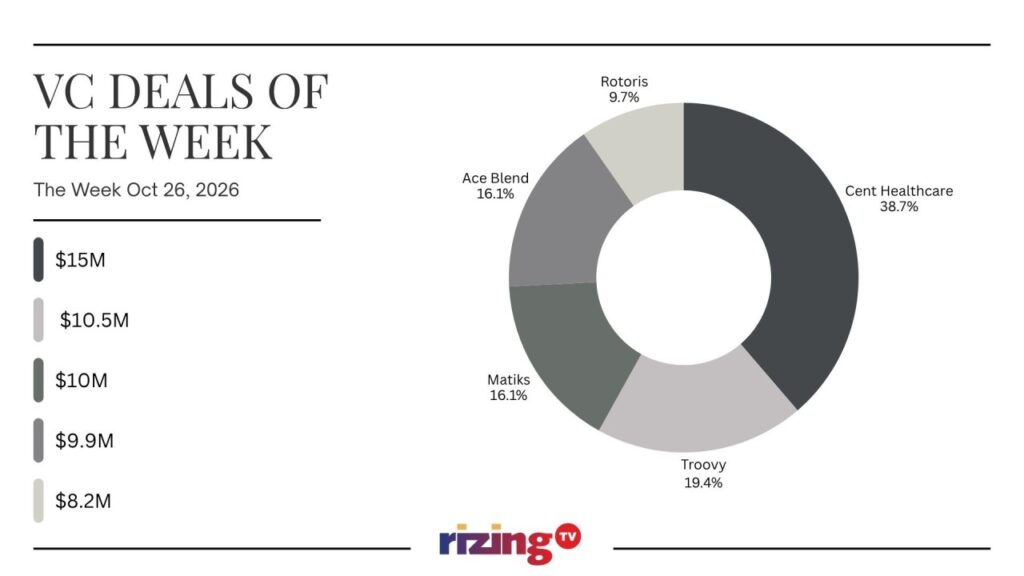
As per the report by the database company Venture Intelligence, Indian startups raised about $100 million across 27 deals this week. That is more deals than the year’s average pace of roughly 18 to 19 a week, but about half the typical weekly value of roughly $190 million (our arithmetic on the YTD figures of 802 deals and $8,233 million). The average cheque was $3.7 million, against $10.3 million for the year so far. Five deals worth about $52 million made up more than half the week’s money, and none was bigger than $15 million. Deal of the Week: Cent Healthcare We pick Cent for three reasons. It is the largest round of the week, at 15% of total value. It is also the most ambitious, since it is building a new category rather than scaling an existing one. And it is the clearest example of capital following conviction in a company barely a year into selling. Cent raised $15 million (about ₹143 crore) in a Series A led by Blume Ventures and existing investor South Park Commons. Angels including former Vodafone CEO Arun Sarin and former OpenAI executive Srinivas Narayanan also joined, and Cent bought AI radiology firm Medsee alongside the raise. The round mixes debt and equity, and the split was not given in the coverage we found. That matters because the business runs on expensive scanners. The product, Cent Check, is a fixed, two-hour package: full-body MRI, low-dose CT, DEXA scan, ECG and echocardiography, priced at ₹27,500, with AI stitching the results into organ-level risk scores. The company says it has done 10,000 scans across Bengaluru, Mumbai and Delhi NCR and wants to reach 1 crore by 2035. The founders include Practo co-founder Shashank ND practo, ex-Ola Electric CMO Anshul K. and ex-Lenskart product head Arpit Garg . The investors Blume is an early-stage, India-focused fund that backs seed and Series A rounds. It has a history in healthcare, including BeatO, HealthAssure and Virohan, and says it manages over $800 million. This week it led two of the top five deals, Cent and Rotoris. South Park Commons is the more unusual name. It was founded in 2015 as a community for founders who have not yet settled on an idea, and its Fund III raised $275 million in 2025, alongside a $40 million India fund. It backed Cent’s seed round and has now doubled down. A repeat cheque from the earliest institutional backer is a useful signal. The rewards The pitch is simple. Most Indian health checkups lean on blood tests, while a standalone full-body MRI done conventionally costs ₹50,000 to ₹60,000 by the founders’ account. Cent says AI has cut scan time to about 30 minutes, which makes the economics work. The scan data could also become an asset in itself: Cent plans to use it to build health baselines for Indians and train risk models. Its target customers are mostly people near 45 earning ₹15 to ₹20 lakh a year, and it plans a membership to bring them back. If the model works, it is a recurring-revenue healthcare brand with a data advantage. The risks Retention. The protocol is meant to be taken about once a year, and the founders themselves have called retention a significant question. Capital intensity. Cent told Inc42 in July that its biggest cost was capex for 20 to 25 new centres within six to nine months. Scanners are costly, so a debt component is understandable, but it adds fixed obligations. Utilisation. Each of its three centres can handle up to 3,000 scans a month. The company reported about 7,000 cumulative scans in July and 10,000 now, which implies roughly 1,000 a month since. At the list price that is about ₹2.75 crore of monthly billings, a back-of-envelope figure, and well below what the stated capacity could generate. We would ask the company to reconcile this. Clinical value. Clinicians have long debated screening healthy people with whole-body scans, because incidental findings can trigger anxiety and follow-up tests. Cent says about 25% of customers are flagged for something major and 3% for something critical, which supporters will read as proof of value and sceptics as a warning about over-detection. Founder bandwidth. Shashank also runs Practo , which is reported to be heading for an IPO. Other notable deals Troovy. The kids’ snack brand raised ₹100 crore (about $10.5 million) in a Series B led by existing investor Fireside Ventures , with Sharrp Ventures | Harsh Mariwala Investment Office participating, to expand manufacturing, new categories and offline distribution. It follows a $5 million Series A in January, and Fireside says the brand grew five times in the eight months after that. A separate report had Troovy eyeing a ₹200 crore round led by the Abu Dhabi Investment Authority; how that relates to this raise is unclear. Matiks . The Bengaluru social gaming platform raised $10 million (₹95.1 crore) in a pre-Series A led by General Catalyst , with Ronnie Screwvala and existing backers Info Edge Ventures , Tanglin and Untitled Ventures. TechCrunch reports daily users grew from 22,000 earlier this year to over 300,000 by September, taking total funding past $13.5 million. The next test is turning a fast-growing user base into revenue, and its AI game-creation tool is still experimental. Ace Blend . The nutrition brand raised $9.9 million (about ₹95 crore) in a Series A2 led by 3one4 Capital , with Fireside participating, to fund clinical trials and expand its range of around 14 products. The company claims 300% growth in FY26 and over 46% repeat purchases, both company-reported and unaudited. Fireside’s second cheque after leading its $3.3 million pre-Series A is the reassuring part. Rotoris . The Gurugram watchmaker raised ₹70 crore in a Series A led by Blume, with 9Unicorns, Centricity WealthTech and several family offices. It launched 2,100 numbered watches in February and says they sold out within days. StartupTalky noted that at website prices that is roughly ₹13 to ₹27 crore of sales, a reminder that […]

RizingTV

Deals of the Week for 19th October

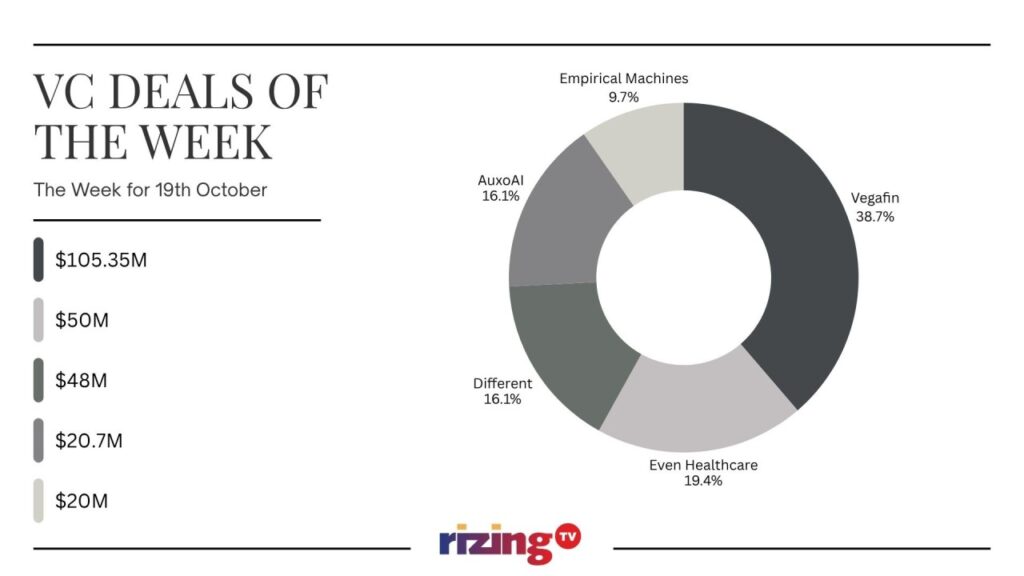
Macro Venture Capital Landscape Overview During the week of October 19, 2026, to October 23, 2026, the venture capital ecosystem recorded 20 distinct transactions totaling 323 million US dollars in disclosed funding value. This mid-October performance brings the 2026 year-to-date total to 775 deals valued at an aggregate of 8,133 million US dollars. The week’s capital deployment demonstrates continued investor confidence in enterprise artificial intelligence, fintech infrastructure, healthcare management, and cross-border platforms. Deal of the Week: Vegafin Secures 105.35 Million US Dollars The standout transaction for the week is the massive 105.35 million US dollar financing round secured by artificial intelligence-driven micro, small, and medium enterprise lending platform Vegafin. This transaction earns the designation of deal of the week due to the extraordinary scale of capital injected into an early-stage enterprise leveraging advanced artificial intelligence to transform credit underwriting and distribution for India’s vast, traditionally underserved MSME sector. By deploying algorithmic risk models and automated underwriting systems, Vegafin is tackling one of the most stubborn credit gaps in the domestic economy, enabling rapid scaling without the prohibitive overhead of traditional branch-based banking models. Investor Profile and Strategic Rationale The investment syndicate backing Vegafin brings together elite institutional heavyweights with deep expertise in scaling financial technology and high-growth digital platforms. PremjiInvest, the prominent family office and investment arm associated with Wipro ’s Azim Premji, provides substantial growth capital and long-term institutional backing. Norwest Venture Partners contributes multi-stage global venture experience, specifically in fintech and enterprise software architectures. Lok Capital adds specialized impact and growth investing perspective, focusing on financial inclusion and sustainable livelihood-building enterprises across emerging markets. Risks and Rewards of the Investment Investing in a digital lending platform carries a distinct and carefully calculated risk-reward matrix. On the reward side, capturing a slice of India’s multi-billion-dollar MSME credit gap offers immense revenue potential, especially when automated risk models can drastically lower customer acquisition costs and improve loan turnaround times. Conversely, the primary risks involve inherent credit default cycles, vulnerability to macroeconomic and supply chain shocks among small businesses, and navigating rapidly evolving regulatory frameworks governing digital lending and algorithmic credit decisions in India. Other Notable Transactions of the Week Beyond the headline-grabbing fintech transaction, the weekly report card features significant investments across healthcare technology, cross-border software, and specialized artificial intelligence. Integrated health management enabler Even Healthcare raised 50 million US dollars from institutional backers Alpha Wave Global and Khosla Ventures , highlighting growing investor appetite for integrated care delivery models that combine healthcare financing, insurance, and direct medical services. In the cross-border software space, US-India B2B marketing platform Different secured 48 million US dollars in a high-profile funding round backed by Firebolt Ventures , General Catalyst Partners, Lightspeed Ventures, Together Fund , and others. Within the burgeoning enterprise AI and deep-tech sectors, enterprise AI agent enabler AuxoAI raised 20.7 million US dollars from participating entities, reflecting surging demand for autonomous workflow automation systems. Additionally, scientific discovery-focused artificial intelligence company Empirical Machines secured 20 million US dollars in funding backed by Peak XV Partners and Mettle Capital , targeting automated research and deep-tech laboratory discovery workflows.

Scroll to Top