
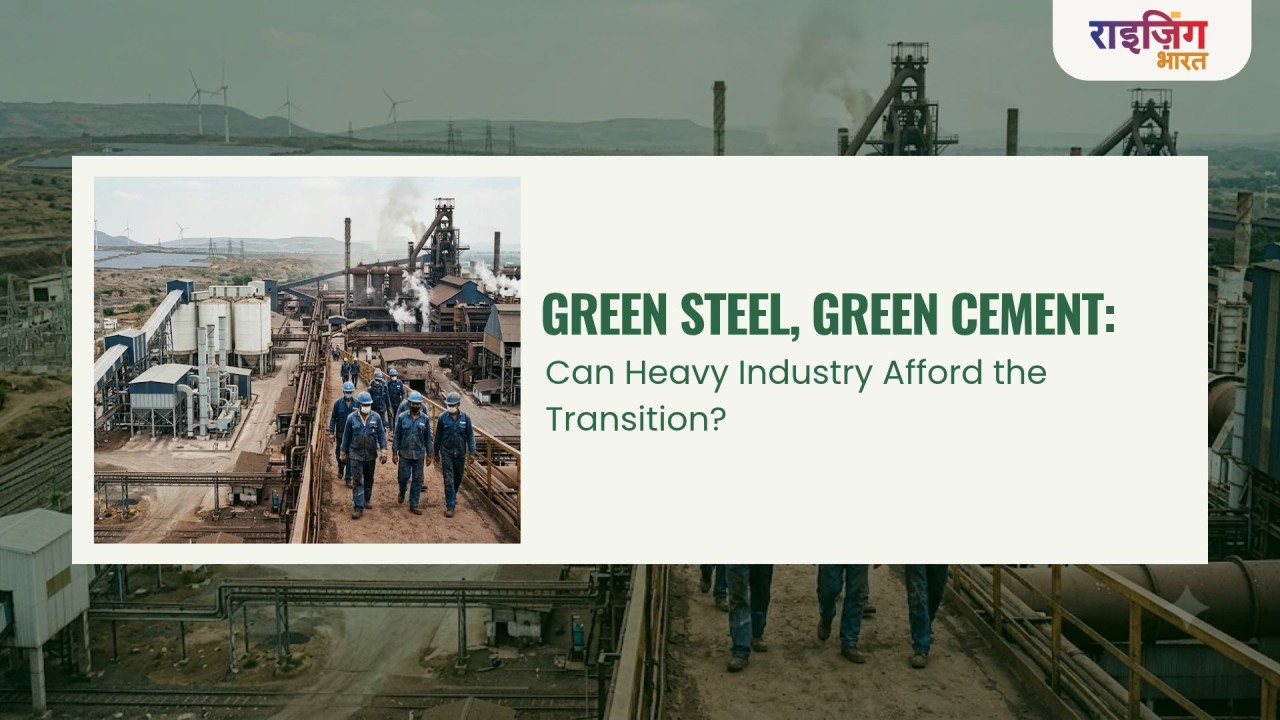
Green Steel, Green Cement: Can Heavy Industry Afford the Transition?
 By sonali.kohli
26 Nov 2026
3 min read
India’s infrastructure ambitions depend on two materials that are also among its most carbon-intensive: steel and cement. Every new highway, bridge, factory and housing project adds to demand for both. But as the country expands its industrial capacity, manufacturers face a difficult question: how can they produce more without significantly increasing emissions, and who will pay for the transition?
The scale of the challenge is substantial. India is the world’s second-largest steel producer, while its cement industry has an installed capacity of more than 620 million tonnes. According to NITI Aayog, cement manufacturing contributes around 6% of India’s total greenhouse gas emissions, with an average emission intensity of approximately 0.63 tonnes of CO₂ per tonne of cement. Nearly 60% of these emissions come from the chemical process of converting limestone into clinker, the key ingredient in cement.
For steel, the difficulty lies in its dependence on coal-intensive production. The blast furnace-basic oxygen furnace route remains a major part of India’s steelmaking mix. Replacing this process with lower-emission alternatives requires significant investment in new equipment, reliable renewable electricity and, potentially, green hydrogen. NITI Aayog estimates that hydrogen-based direct reduced iron and electric arc furnace production currently requires 30–40% higher capital investment and 15–25% higher operating costs than conventional alternatives, at prevailing green hydrogen prices.
The government has begun creating a framework for the transition. India’s Green Steel Taxonomy sets emission-intensity thresholds and assigns ratings based on how much a plant’s emissions fall below the prescribed benchmark. By the end of FY2025-26, 90 steel units had received certification, representing 12.4 million tonnes of production. However, certification is only the starting point. The Ministry of Steel acknowledges that hydrogen-based steelmaking is not yet commercially viable in India and is supporting pilot projects to test different applications of hydrogen in existing and new production processes.
Cement offers some more immediate opportunities. Manufacturers can reduce emissions by replacing a portion of clinker with alternatives such as fly ash, slag and calcined clay, improving kiln efficiency, using renewable electricity and substituting coal with waste-derived fuels. NITI Aayog’s January 2026 roadmap identifies clinker substitution as an economically viable measure that can deliver emissions reductions while saving around ₹1,600 per tonne of CO₂ avoided. Carbon capture, utilisation and storage could address emissions that cannot be eliminated through these measures, but remains expensive and requires supporting transport and storage infrastructure.
The commercial question, therefore, is not simply whether cleaner production is technically possible. It is whether buyers are prepared to create a market for it. Steel manufacturers need predictable demand to justify investments, while cement producers need construction companies and infrastructure developers to recognise the value of lower-carbon materials. Public procurement could play an important role by creating early demand and helping producers recover some of the additional costs.
For heavy industry, waiting also carries risks. Global supply chains are increasingly paying attention to the carbon footprint of materials, and exporters face growing pressure to demonstrate lower emissions. Companies that delay investment could eventually find themselves at a disadvantage in markets where carbon performance influences competitiveness.
India cannot decarbonise steel and cement overnight, nor can it absorb every additional cost without considering the impact on infrastructure and manufacturing. The transition will require patient capital, technological development, reliable clean energy and clearer demand signals.
The real test is whether India can make greener materials commercially practical before rising industrial demand locks in another generation of high-emission infrastructure.